How to reboot your corporate incubator
In 2023, for TechSummit Amsterdam, I was presenting a keynote about proper strategies for rebooting your typical corporate incubator. Everything I presented is still, I believe, pretty much on the table.

Many incubation teams recognize the same ending: after two to three years, priorities shift, budgets get tighter, and someone comes knocking at the incubator door asking what's been done, and why the team can't account for more. Things rapidly get ugly, and the program is shafted, then rebooted after a while, repeating the same cycle over and over again.
The core problem you're facing as an incubation program director or manager is that incubation is forced to mimic the logic of a core business, like linear planning, deterministic roadmaps, and a unique ROI outcome: birthing new scalable businesses. Nothing really works that way for proper innovation.
There's always a "way out," and a few key fixes could help you boot everything back on track and become an active contributor to the core business.
Kill the pipeline illusion
A pipeline is comfortable and reassuring. It suggests a stable sequence starting with ideas, enrichment, validation, prototyping, then a few manageable pilots, and eventually... scale. But incubation does not behave like a production line; it behaves like playing a casino (a casino you can beat, mind you, if you understand how to play.)
Most innovation teams, though, prefer to reassure top executives and explain how 300 ideas will produce 1-3 new businesses in a controllable, budget-efficient way. Houston, we have ROI!
Of course, if you pause for only a minute, pretending that anyone can sort out which ideas are best to launch three years from now in a market we don't even understand what color or shape it will have, is quite astounding.
The first shift is both cultural and structural.
It's a hard shift that requires facing the truth: you can't predict what to launch in a future market, but you can hedge bets, create options, and prepare different approaches to different possible futures. This requires treating innovation as a non-linear endeavor that enables regular business units to launch new businesses faster than competitors and with sharper alignment with future market needs.
In that sense, a corporate incubator should be able to deliver one key ROI: 6- to 12-month head starts for the rest of the business to anticipate or adapt to the most unpredictable market turnarounds.
Show and tell your portfolio
So, when asked what your program delivers, instead of showing a pipeline of ideas that inevitably get killed along the way or fully funded while the market has already shifted to entirely different needs, the critical tool you should show is your portfolio of options.
A portfolio embraces non-linearity.
Its elegance and efficiency lie in its ability to cover a wide variety of strategic (not random!) bets without trying to predict anything really. A portfolio leverage volume: you need enough bets to be sure several of them will be productive.
And it's technical too. It spans different types of risks and opportunities, some more market-driven, some more tech-driven, and many in between, with varying expected time-to-outcome. (I promise it's much simpler than it sounds right now.)
Right away, the best-selling point, or sign of quality, you will have is being able to show an efficient spread of bets, both in quantity, directionality, and quality. This is, by the way, my immediate and most trustworthy metric when preparing to work with an innovation team: how many projects are spread across market/tech opportunities at 1, 3, and more than 5 years.
Explain your smart
Link to this, "smart" innovation team doesn't brag about seeing the future, or betting all in on a key technology or business model. They brag about maximizing opportunities within budget constraints: "With the same budget as last year, we managed to explore 50 opportunities, instead of only 30." And don't forget: "Three of them have already been picked up by business unit X and Y, and we're helping them implement as we speak."
Optionality means building cost-effective positions with limited downside, maximized learning, and strategic upside if the market becomes aligned. Said differently, optionality looks like fast tests that reduce uncertainty, explore multiple paths to value as the future is created, rather than creating wishful business case fictions ahead of time.
It's also genuinely difficult to explain to executive committees that pilot businesses should just react to the stock market.
I know. Trust me, I feel your pain.
One project, three ROIs
This is another golden rule. As we build for unstable, unpredictable conditions, we need to leverage every bit of every project (since most of them are bound to fail).
One of the most straightforward things you have to do when setting up an innovation project within your incubator is to ask these three questions in this precise order:
- When it fails, what will we still have to learn that is critical for our core business? This also means: who is the internal customer for this information, why do they need it, and how to improve the quality of the information so that they can leverage it before our competitors?
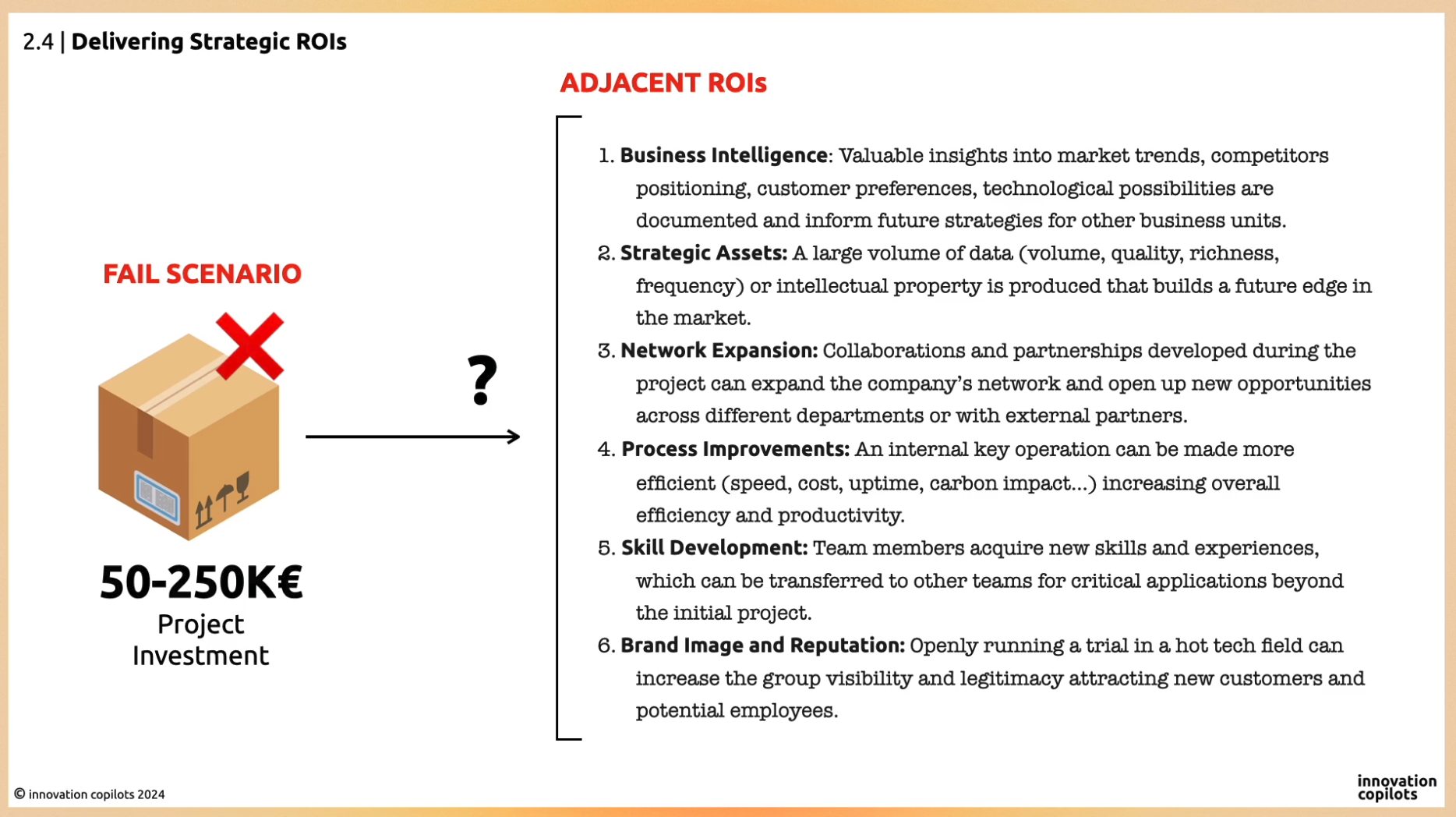
- Before it fails, will it unlock a new asset for our core business? Again: who's the internal customer, what kind of asset are we talking about (a new piece of future-proof tech, a leaner process, access to a hidden market, new customer data...), and do we make sure it's immediately transferable?
- If it doesn't fail, how do we transfer the early success for scale within the company? Same story: internal customer, conditions of success, etc.
This is what optionality also means: you can't really fail.
And as an example, here are further "unlockable assets" you can aim for:
Secure internal customers, not sponsors
As a final point (to keep it short), I'm always surprised by the lack of internal support corporate incubators really try to build.
Sure, most program directors know how to play politics and find interesting sponsors, sometimes even at the board level. But even with that, they can only secure 2-3 years of budget for generic innovation promises ("seeing the future" and "building next-gen businesses").
Very few actually take the time to find their internal customers.
Which are the business units facing the most uncertainties or direct troubles in the next two years? Which are the ones that are too big to fail but don't really have hedged anything if their master plan is challenged? Or which are the ones upon and coming but lacking resources to push through as fast as they should?
These are your internal customers.
The ones in need of market intelligence collect on the ground by trying to sell new things to yet-to-be-known customers, prototyping and learning fast about new digital distribution channels, or on the lookout for new critical, smart partnerships...
A sponsor is a political asset for your program, but an internal customer is a stakeholder who will find it useful and efficient to funnel budget to you, and eventually broadcast how much ROI you created for them.
In short...
I could go on for a while, but these are seriously effective starting points:
- Run innovation as a portfolio of acceleration opportunities, not a product pipeline.
- Manage risk by creating multiple ROIs to unlock value even in failure mode.
- Aim for internal customers who can't manage risk on their own, rather than sponsors.
When a company says it wants innovation it often means it wants the feeling of the future without the discomfort of uncertainty. Incubation teams end up carrying that discomfort on behalf of everyone